March 22, 2014

FLUID MECHANICS-1


LECTURE NO. 1 BY ENGR. NOORIMA MASUD

CHAPTER NO. 1                                          INTRODUCTION


FLUID:

It is defined as; A substance that continuously deform when acted upon by shearing stress of any magnitude. Fluid are a subset of the phases of matter and include liquids, gases, plasma's and , to some extent, plastic solids. 
Or
Any substance which can flow under the normal condition of temperature and pressure is called fluid.
for example;
  • water flow in pipes, rivers, streams etc.

FLUID MECHANICS: 

Is concerned with behavior of fluids ( liquids and Gases) at rest or in motion.
Or
The mechanics of fluids (including water)
For example;
  • water in a container etc.

HYDRAULICS:

The word 'Hydraulics' has been derived from Greek word ' Hudour', which means water. Thus the subject of Hydraulics may be defined as that branch of Engineering- sciences, which deals with water ( at rest or in motion ).

BRANCHES:

  1. Fluid Statics
  2. Fluid Kinematics
  3. Fluid Dynamics

1. FLUID STATICS:


It is the branch of fluid mechanics which deals the fluids at rest or moving with uniform velocity is known as fluid statics. it embraces the study of the conditions under which fluids are at rest in Stable equilibrium.
Shearing stresses are Zero at this case.
For example; 
  • Water in a glass, Container etc.

2. FLUID KINEMATICS:

It is the branch of fluid mechanics which deals the fluids with motion , by without considering any type of external forces is known as fluid kinematics.
For example;
  • Water falls ( under the action of gravity ).
 

3. FLUID DYNAMICS:

It is the branch of fluid mechanics which deals the fluids with motions, by considering the external forces are involved is known as fluid dynamics.
For example;
  • Pump the water from down, 
  • Water in a pipe,
  • CNG in cylinder etc.

PROPERTIES OF FLUIDS:

Ordinary, there is no difficulty in distinguishing a liquid from a gas or a solid;
a solid has a definite shape, which it retains, until some external force is applied to alter it. On the contrary , a liquid takes the shape of a vessel, into which it is poured. On the other hand, a gas completely fills up the vessel which contains it.
Among the liquids water will be mostly dealt , which has the following properties:
  1. Density
  2. Specific Weight
  3. Specific gravity
  4. Compressibility
  5. Surface tension
  6. Capillarity
  7. Viscosity.


1. DENSITY OR MASS DENSITY:

Density or mass density of a fluid is defined as; 
The ratio of mass of fluid to its volume. Thus mass per unit volume is called density or mass density. 
It is denoted by a symbol ฯ (rho).
The SI unit of mass density is Kg/m3.
Mathematically 


  • The density of water is 1 g/cm3 or 1,000 Kg/m3 or 1.94 Slug/ft3.
  • The Density of Mercury is 13600  Kg/m3.

Note: The variation in the density of water , with the variation of pressure and temperature is so small, that for all practical purposes it is generally neglected.

2. SPECIFIC WEIGHT OR WEIGHT DENSITY:

Specific weight or weight density is the ratio between the weight of a fluid to its volume. Thus the weight per unit volume is called specific weight. The SI unit is Kpa or  KN/m3 .
It is denoted by (Gamma)  แตž .
Mathematically;


Note: The variation of specific weight of water , with the variation of pressure and temperature is also so small, that for all practical purposes it is generally neglected.

For all calculation related to Fluid mechanics , Hydraulic Machines etc. the specific weight of water is 9.81 KN/m3 or 62.46 lb/ft3.The Specific weight of mercury is 132.8 KN/m3 

3. SPECIFIC GRAVITY:

Specific gravity is defined as ;
The ratio of  specific weight of a fluid to the specific weight of standard fluid. For liquid the standard Fluid is taken Water, and for gases the standard fluid is taken air. Specific gravity is also called relative density. It is dimensionless quantity and is briefly written as sp. gr.
Mathematically;
for liquid 


Note: If density of a liquid is in ton per m3 (t/m3), it is numerically equal to specific gravity of the liquid.

You can place your request for any kind of E-book, Lecture notes, Lab- Manuals, Presentations etc. Through below Comments Box System.


CHAPTER NO 1


SOLUTION MANUAL OF HYDRAULICS, FLUID MECHANICS AND HYDRAULIC MACHINES BY R.S. KHURMI

INTRODUCTION


EXERCISE 1.1
1. Determine the mass density of an oil, if 3.0 tones of the oil occupies a volume of 4 m3.
    Sol: Given data:

Mass = m = 3.0 tones                          : - 1 ton = 1,000 Kg
           = 3.0 × 1,000
           = 3,000 Kg
Volume = V = 4m3

Required:
Mass density of oil = ฯ =?

We know that;


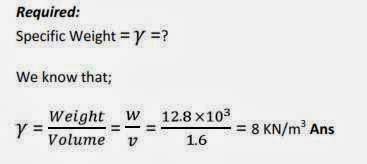
2. A certain liquid, occupying a volume of 1.6 m3, weight 12.8 KN. What is the Specific weight of the liquid?

Sol: Given data:

Volume = V = 1.6 m3

Weight = W = 12.8 KN


3. A container of volume 3.0 m3 has 25.5 KN of an oil. Find the specific weight and mass density of the oil.

Sol: Given data:

Volume = V = 3.0 m3
Weight = W = 25.5 KN

Required:


4. What is the specific gravity of a liquid, whose specific weight is 7.36 KN/m3?

Sol: Given data:


Required:
Specific Gravity = Sp. gr =?

We know that;


5. A drum 0f 1 m3 volume contains 8.5 KN an oil when full. Find its Specific weight and specific gravity.

Sol: Given data:
Volume = V = 1 m3
Weight = w = 8.5 KN

Required:


QUESTIONS


1. Define the density of a liquid?
Ans: The density or mass density of a liquid may be define as ; the ratio of mass of fluid to its volume at a standard temperature and pressure. Thus mass per unit volume is called density. It is denoted by ฯ (rho). The SI unit of mass density is Kg/m3 (Kilogram per Cubic meter).
Mathematically, mass density as;
The density of water is 1 g/cm3 or 1,000 Kg/m3or 1.94 Slug/ft3.


2. Differentiate b/w Specific Weight and Specific Gravity of an oil.
Ans: Specific weight of oil:
The specific weight or weight density of a liquid may be defined as it is the ratio b/w the weight of fluid to its volume. Thus weight per unit volume of fluid is called Specific weight or weight density and it is denoted by ฮณ.The SI unit of Specific weight is KN/m3.
Mathematically; 

  • Different oil’s having different Specific weight.


Specific Gravity of oil:
Specific gravity is defined as, the ratio of Specific weight of Liquid to the Specific weight of a standard fluid. For liquids the standard fluid is taken water and for gases, the standard fluid is taken air. Specific gravity is also called relative density. It is dimensionless quantity and it is denoted by the symbol S or (briefly written as Sp. gr).
Mathematically;
For liquids;


Note: If density of a liquid is in ton per m3 (t/m3), it is numerically equal to specific gravity of the liquid.

3 .What is the ratio b/w Specific weight and mass density of a liquid?
Ans: we know that;


4.  Distinguish b/w compressibility and capillarity of water?
Ans:
Compressibility of water:
         It is defined as; if the density or volume changes with the changes of pressure then the fluids are called compressible fluids. The SI unit is N/m3.
         The variation in the volume of water, with the variation of pressure is so small that for all practical purposes it is neglected. Thus, the water is considered to be in-compressible liquid.

Capillarity of water:
          Capillarity is defined as; the rise or fall of liquid in a small glass tube due to cohesion and adhesion is called the Capillarity or capillary rise. The SI unit is m (meter).
          When a glass tube of small diameter is dipped in water, the water rises up in the tube with an upward concave surface. This is due to reason that the adhesion (b/w the tube and water molecules) is more than the cohesion b/w the water molecules.
          The phenomenon of rising water in the tube of smaller diameter is called the capillary rise.

5. What role does the surface tension of liquid play, when a glass tube of small diameter is dipped into it?
Ans: The surface tension of a liquid is its property, which enables it to resist tensile stress.
OR
The cohesive forces b/w the liquid molecules are responsible for the phenomenon known as surface tension.
When a glass tube of small diameter is dipped in water, the water rises up in the tube with an upward concave surface. This is due to reason that the adhesion (b/w the tube and water molecules) is more than the cohesion b/w the water molecules.


You can place your request for any kind of E-book, Lecture notes, Lab- Manuals, Presentations etc. Through below Comments Box System.

March 21, 2014

SOLUTION MANUAL OF HYDRAULICS, FLUID MECHANICS AND HYDRAULIC MACHINES BY R.S. KHURMI


SOLUTION MANUAL OF HYDRAULICS, FLUID MECHANICS AND HYDRAULIC MACHINES BY R.S. KHURMI


                  S.No                                Chapter Name 


                       1.                                    Introduction                      

                       2.                                    Fluid Pressure and its Measurement 

                       3.                                    Hydro statics           

                       4.                                    Hydro Kinematics

February 28, 2014

FLUID MECHANICS , LABORATORY MANUAL


LIST OF EXPERIMENTS


1. To study working and different Parts of HydraulicBench.

2. To Calibrate a Bourdon type Pressure Gauge Using aDead Weight Pressure Gauge Calibrator.


6. To investigate the validity of Bernoulli’s Theorem as applied to the flow of water by Bernoulli’s Theorem demonstration.

7. Flow through Sharp Edged Orifice.

8. To Prepare the Classical Experiment Conducted by Reynolds’s Concerning Flow Conditions.

9. To verify the theoretical expression for the force exerted by Jet striking normally on the flat plate (Impact of Jet).

10. To determine the characteristic of   Pelton Wheel apparatus at various speeds.

11. To determine the characteristic of   Francis Turbine apparatus at various speeds.

12. To determine the characteristic of   Kaplan Turbine at various speeds.

13. To Prepare the Classical Experiment Conducted by Reynolds’s Concerning Reynolds’s Number Calculation.

14. To determine the head/ flow characteristic of Centrifugal pump at various speeds.

15. To determine the head/ flow characteristic of Turbine Pump at various speeds.

16. To determine the head/ flow characteristic of Reciprocating Pump at various speeds.

17. To determine the head/ flow characteristic of Axial Flow Pump at various speeds.

18. To determine the Metacentric height of a Ship Modle.

19. To determine the velocity of water flow with the help of pitot tube.

20. To determine the coefficient of discharge of sharp crested weir.

21. To determine the coefficient of discharge of  ogee weir.

22. To determine the coefficient of discharge of a broad crested weir.

23. To determine the the head loss through hydraulic jump.

24. To determine the coefficient of discharge of the venture flume.


FLUID MECHANICS , EXPERIMENT # 6


FLUID MECHANICS , EXPERIMENT # 5


To determine the discharge and co-efficient of discharge over a triangular notch

APPARATUS:

  • Triangular Notch
  • Hook and point gauge
  • Hydraulic bench
  • Stop watch

THEORY:

1. Notch:

An opening provided in the tank / vessel in which the top edge of the opening lies below the water surface.

2. Orifice:
An opening in the tank / vessel in which the top edge lies below the water surface level, both the orifice and notch are used directly for discharge.

3. Weir:
A structure, used to dam up a stream or river, over which the water flows, is called a weir.

Difference b/w Notch & Weir:

  • Notch is of small size and weir is of a bigger one.
  • Notch is usually made in plate, whereas a weir is usually made of masonry or concrete.

4. Jet:

The water issuing from an orifice is called jet.

5. Sill or Crest:

The top of the weir or notch over which the water flows, is known as Sill.

6. Nape or vein:

The sheet of water flowing through a notch/weir is called Nape/ vein.

7. Triangular Notch:

Let,
  • H = Height of the liquid above the apex of the notch
  • ฮธ = Angle of the notch
  • Cd = Coefficient of discharge

From the geometry of the figure, we find that the width of the notch at the water surface,

Area of the strip:

We know that the theoretical velocity of water through the strip


and discharge over the notch,


The total discharge over the whole notch may be found out only by integrating the above equation within the limits 0 and H.

  •       A triangular notch gives more accurate results for low discharges than rectangular notch And the same triangular notch can measure a wide range of flows accurately.


  •    PROCEDURE:
  •     1. I fixed the plate having a      triangular notch in the water passage of hydraulic bench.
  •     2. .Then I turned the hydraulic bench “ON” and the water started accumulating in it & when the         water level reached the crest of the notch, stopped the inflow & noted the height, let it be H1.
  •    3. Then started the inflow, Noted the value and time for its accumulation, this gave the               discharge. Also noted the height of water level for discharge, Let it be H2.
  •    4. Then H2-H1 gives the head over the notch.
  •    5. Also noted the angle of notch
  •    6. I took different readings by changing the discharge, head over the notch and tabulated flow.

  •    PRECAUTION:

  •        1.The amount of water should be added very carefully.

  •        2. The stopwatch reading must come in zero after each reading.

  •       3. Different readings should be taken for different discharge.


  •          S /no
          Vol(lit)
            Time
          (sec)
    Q act
           H1 
           (cm)     
           H2
           (cm)
           H
           (m)
    Qth 
            =8/15√2g tan(ะค/2)H5/2
           Cd
          =Qact/Qth
           Q
           (lit/s)
              Q
         (m3/s)
        1.


        2.


       3.


  • You can place your request for any kind of E-book, Lecture notes, Lab- Manuals, Presentations etc. Through below Comments Box System.


    Twitter Delicious Facebook Digg Stumbleupon Favorites More

     
    Design by Free WordPress Themes | Bloggerized by Lasantha - Premium Blogger Themes | coupon codes